Arsenal’s Right-Side Blueprint: How Saka, Ødegaard, and Timber Are Driving the Attack

Every Arsenal fan can see it. The ball goes right. The team’s most dangerous movements start there and often end there. It is deliberate, rehearsed, and built around Bukayo Saka, Martin Ødegaard, and Jurrien Timber.
This is not a tactical accident or a stopgap for missing players. It is the framework of Arsenal’s attack. The data show how this right-side structure changes the way the team moves, creates, and defends. It is a plan that amplifies Arsenal’s best player and links him with two others who match his precision.
Quantifying What’s Clear on the Pitch
The eye test already shows Arsenal’s right-side dominance. The data describe its detail.
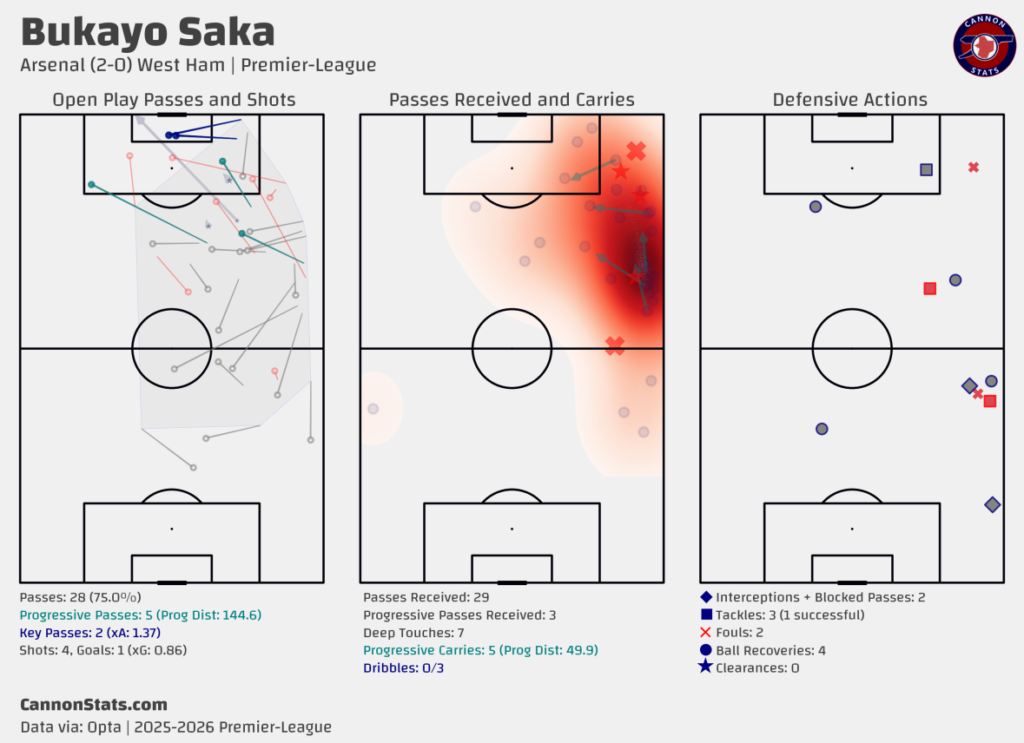
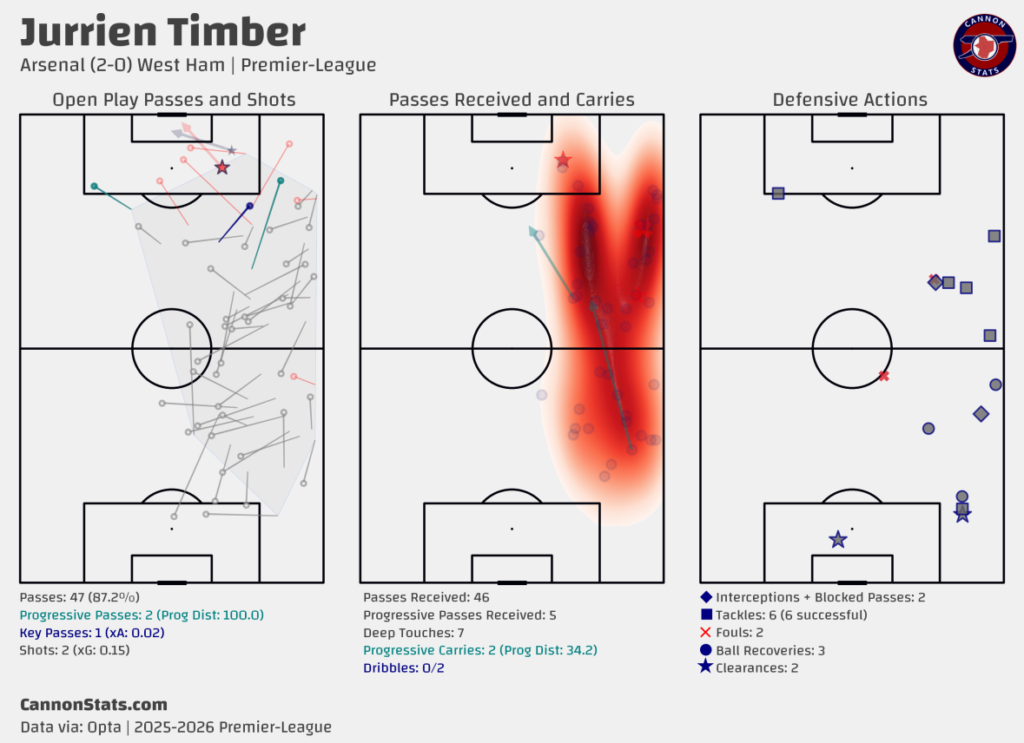
Saka’s maps from the City, Newcastle, and West Ham matches show heavy touch volume on the right channel, with eight to eleven progressive carries and consistent deliveries into the box. Timber’s maps mirror that pattern, recording multiple progressive passes and overlapping runs into the same corridor.
Against Manchester City, Saka had 11 progressive carries and eight deep touches. Timber added five progressive passes and six carries. Newcastle followed the same pattern. Saka made 29 receptions and seven carries, Timber seven progressive passes and two shots. West Ham confirmed the template, with Saka’s seven deep touches and four shots supported by Timber’s six successful tackles and two carries. The pattern is not improvisation. It is the method by which Arsenal control territory and chance creation.

Ødegaard’s Role in the Chain
Martin Ødegaard connects everything. His maps from Newcastle and West Ham show him operating between the right half-space and central channel, always within short passing distance of both Saka and Timber.
His influence has fluctuated with fitness, but the system protects against overload. When Ødegaard drops off or drifts inside, Martin Zubimendi steps in to recycle play and feed Saka earlier in buildup. The rhythm remains constant: ball progression through Timber, combination through Ødegaard, final action through Saka.
This rotation has lowered the number of touches needed to reach the box. The attack is faster, cleaner, and less reliant on one individual to break a line.
Eze’s Creative Fit in the Central Role
Eberechi Eze offers a different type of control when deputizing for Ødegaard. His dribbling threat and ability to carry through pressure give Arsenal a more vertical form of progression. Where Ødegaard prefers quick combinations and tempo management, Eze invites contact, breaks lines with movement, and commits defenders before releasing the final pass. That style could tilt the rhythm slightly, creating more direct routes into Gyökeres or wide runners without disrupting the right-side structure. His comfort in half-spaces means the shape remains intact, but the attacking transitions gain another layer of unpredictability.
The Midfield Platform
Zubimendi and Declan Rice anchor the pattern. Zubimendi’s West Ham performance—72 passes at 94 percent accuracy with six progressive carries—shows his value as the reset point behind the attacking trio. Rice’s Newcastle display included six progressive passes and five carries. Both alternate their coverage to allow Timber to advance.
The partnership provides control without blunting aggression. When Timber pushes high, one midfielder covers the half-space while the other positions for a switch. This balance gives Arsenal freedom on the right and stability through the center.
Gyökeres: The Anchor That Balances the Tilt
Viktor Gyökeres operates largely outside the rhythm of Arsenal’s right-sided buildup, but his influence amplifies it. His hold-up play and physical strength pin central defenders and often draw a covering midfielder, freeing space for Saka and Ødegaard to combine in tighter zones. Even when he receives few touches, his gravity shifts defensive attention inward, creating the half-space channels Arsenal exploit so well. It’s a complementary relationship rather than a disconnected one. His presence stabilizes the structure, allowing the right side to function with purpose and precision. And when his goals begin to flow, defenders will be forced to collapse even tighter around him, opening those wide and half-space lanes earlier in the buildup giving Arsenal’s right side more time, space, and clarity to create.
The Left-Side Safety Valve
Riccardo Calafiori prevents predictability. His West Ham chart lists six progressive carries and seven deep touches, often drawing defenders away from Saka’s zone. Against City, he added four progressive passes from the left half-space.
Calafiori’s composure under pressure keeps teams from collapsing their shape toward Saka. Gabriel and William Saliba support with secure distribution. Saliba’s West Ham performance included 98 passes and four progressive completions. Gabriel held position, focusing on recoveries and clearances. The left side does not mirror the right. It provides the balance that allows the right to flourish.
End Product Through the Right
The structure has transformed Viktor Gyökeres’ involvement. His Newcastle chart shows 16 receptions, six progressive passes received, and 10 deep touches, most of them in the right channel. Against West Ham he created 1.37 expected goals from two close-range chances, both starting from Saka’s side.
The interaction is predictable but hard to stop. Saka stretches the line. Ødegaard occupies the half-space. Timber overlaps or underlaps, forcing a decision. Gyökeres attacks the space between defenders while Rice and Zubimendi hold shape behind them.
Leandro Trossard and Gabriel Martinelli feed off this movement. When the ball switches, they arrive into gaps instead of facing a set defense. Trossard’s West Ham map shows nine deep touches and seven progressive carries. Martinelli’s Newcastle data include three deep touches and a clean 1v1 dribble. The right side creates the instability that the left side exploits.
Defensive Shape Behind It
A system that attacks from the right must recover quickly. Timber’s six tackles against West Ham highlight how he manages that burden. Rice reinforces it, registering three tackles and five recoveries against Newcastle. Zubimendi’s five tackles against West Ham show similar work rate.
The defensive line stays compact. Raya’s controlled distribution prevents panic clearances and allows Arsenal to reset possession through Rice or Calafiori. The numbers support what the matches show: Arsenal can attack aggressively on one side because they recover the ball fast and circulate it safely.
Why It Matters
The right-side overload is not a temporary fix. It is a design that puts Arsenal’s most dangerous player in charge of their most dangerous space.
When Saka missed the Liverpool and Forest matches with a hamstring injury, the framework was visible but incomplete. The right side still held the shape, but the final product was missing. Once Saka returned, the plan functioned as intended. We all know it, the right side is the foundation of Arsenal’s possession and chance creation.
In the last three matches, Arsenal have averaged more progressive passes, carries, and box entries from the right than from any other area of the pitch. The consistency suggests a mature identity rather than a short-term adjustment.
Finding the Next Layer of Balance
Arteta’s system has evolved to flow toward Arsenal’s right because it houses the team’s most productive trio Ødegaard, Saka, and Timber. That’s not a flaw, it’s a reflection of efficiency. When your best creator, best winger, and most assertive fullback share a channel, the game naturally bends their way. Still, balance remains the next frontier.
The returns of Ødegaard, Noni Madueke, and Kai Havertz give Arteta more ways to diversify that shape without dulling what works. Ødegaard’s fitness restores rhythm and leadership in possession. Madueke’s directness and left-footed threat on the opposite flank could create more aggressive rotations with Calafiori and Martinelli, stretching defenses laterally again. Havertz, if reintroduced as an advanced left-sided outlet, adds height and timing into the box, traits that can complement Gyökeres and force backlines to defend the width of the pitch, not just the right half of it.
Unlocking something comparable on the left won’t reduce the right side’s influence, it will amplify it. When teams can’t overload to stop Saka, Arsenal’s best patterns will have more room to breathe. The goal isn’t to abandon the tilt. It’s to weaponize both wings until opponents can’t tell where the danger starts.
What Comes Next
Three refinements could strengthen the system:
-
Vary the release. Use Timber’s underlaps to find Gyökeres earlier against deep blocks instead of always going wide.
-
Protect Rice’s workload. Let Zubimendi take the first phase when Rice manages his back issue.
-
Keep the left active. Continue to use Calafiori’s hybrid role to create chaos for opponents, keeping Arsenal’s buildup unpredictable and impacting the ability of the right to attack down that channel with a little less pressure.
Arsenal’s right-side structure is clear to anyone watching. The data simply explain how it works and why it succeeds. It is a modern version of balance through dominance: one flank leads the rhythm, the other holds the key to control.

Leave a reply
You must be logged in to post a comment.


