Riccardo Calafiori: Arsenal’s Shape-Shifting Soul
Some footballers play the game that’s in front of them. Riccardo Calafiori seems to play the one he imagines. He bends Arsenal’s structure without breaking it, gliding between defender, playmaker, and destroyer with the kind of intelligence that makes you pause mid-game and think: we haven’t had one quite like this before.
In a team built on precision, he brings flow. In a sport obsessed with roles, he dissolves them.
The Arseblog podcast captured this better than any numbers could.
“Calafiori had another game where you found yourself asking, what are we going to call this position that this guy’s playing?” said James (@Gunnerblog). “It’s certainly not left-back as I know it.”
“I’m no longer surprised about where he pops up or what he’s doing,” added Andrew (@Arseblog). “There’s definitely an element of chaos to it, but it’s controlled. He’s a left-back when defending, but in possession he’s often alongside Rice or Zubimendi — a kind of secondary playmaker from deep.”
That mix of structure and freedom, the tension between order and improvisation, is what makes him feel so different. It’s also what makes him so essential.
The Return That Feels Like a Beginning
It’s strange to call this a second act when the first barely began. Calafiori’s debut Premier League season was stop-start, full of promise glimpsed through the fog of injury and adaptation. You could sense something there, the rhythm, the calmness, the almost painterly way he shaped possession, but it never fully took hold.
This season, it has.
His first sustained run of matches in 2025–26 has made clear what Mikel Arteta saw all along: a player whose profile is so unusual that it changes how Arsenal think. And even with fewer than 8 full 90s to measure as the Canon Stats graphics politely remind us in all-caps, SMALL SAMPLE SIZE the story they tell is vivid.


Calafiori isn’t just fitting into Arsenal’s left side. He’s defining it.
The Data That Feels Like Poetry
The Fullback Template radar shows what the eye already knows: a player who lives in the intersection between risk and reliability.
-
He ranks high in progressive carries (4.21 per 90) and receptions (2.36), proof of constant movement into attacking lanes.
-
His pass efficiency sits around 1.00 — not flamboyant, but relentlessly effective.
-
He wins 57% of duels and 67% of aerials, matching the physical edge of a centre-half to the subtlety of a playmaker.
Look closer, and another picture forms. His Inverted Fullback Template shows similar volume in progressive actions but with a dramatic tilt toward central involvement, passes that cut into midfield lines rather than chase the touchline. It’s the data-shaped echo of what we see on the pitch: a full-back who becomes a pivot, then a playmaker, then a pressure valve.
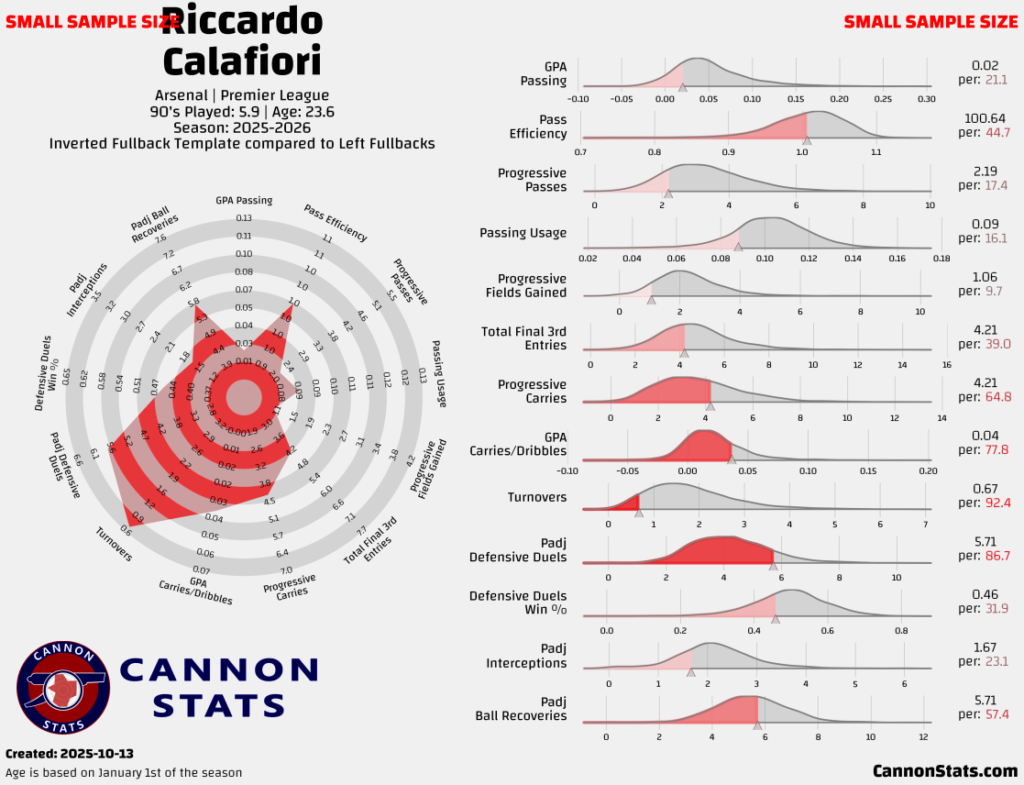
Even his Wing-Back Template (a setup Arsenal rarely start in but often morph into) glows with forward energy. Deep touches inside the final third, controlled carries into the box, and a quietly strong expected-goals contribution, 0.41 non-penalty xG, most of it from headers and late arrivals.
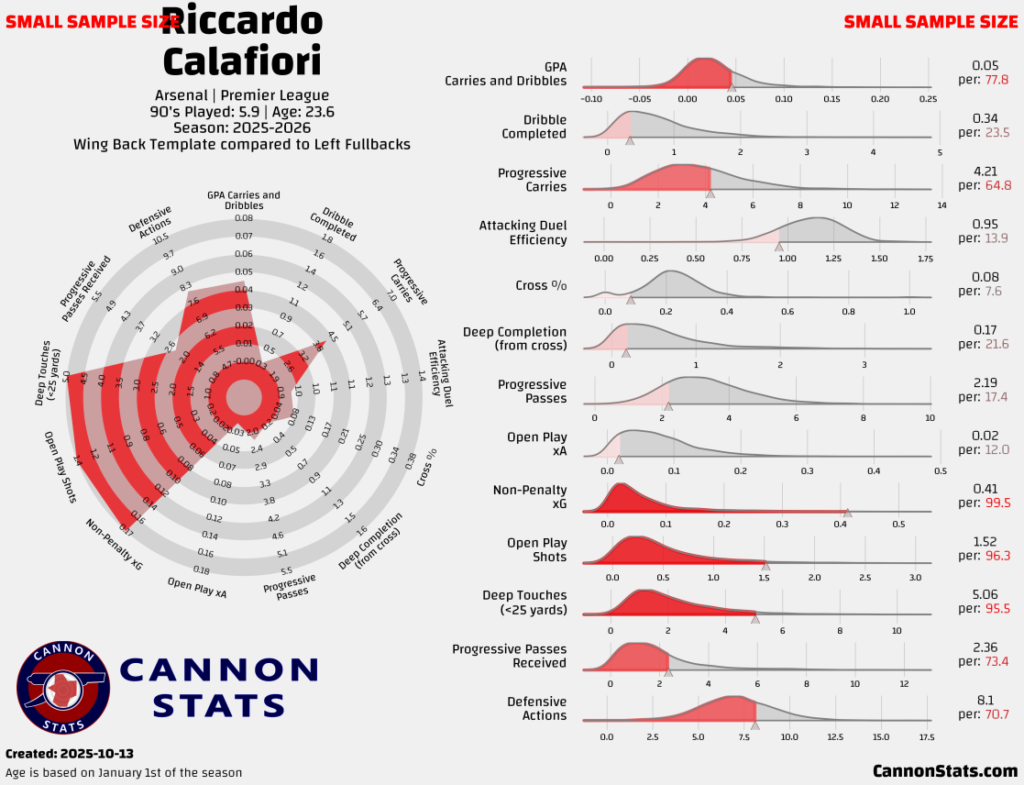
These are the fingerprints of a player who doesn’t just support attacks. He completes them.
Where Structure Meets Instinct
When Arsenal defend, Calafiori’s positioning is textbook: close to Gabriel, side-on, always one step from a recovery run. But once the ball is won, he transforms. He slides into midfield beside Rice or Zubimendi, opening passing lanes like he’s redrawing the pitch. The rhythm of Arsenal’s buildup changes, the tempo rises, then slows, like a song deliberately shifting key.
His Map captures this perfectly. Three open-play key passes so far, all from that left-half-space between full-back and midfielder not the touchline, not the box, but the seam where creativity hides. His one assist comes from the same zone, a pass that looks simple until you see how it tilts the entire defensive line.
The Shot Map tells the rest of the story. Sixteen attempts, mostly from central or near-post spaces. Six of them headers, one goal already scored. It’s not just volume, it’s presence. He’s arriving in the box with timing that feels deliberate, not accidental.
The more you look, the more the numbers sound like Arteta’s words after that Champions League night against Athletic Bilbao:
“He has a special aura. He’s unpredictable for opponents and can make an impact in different spaces on the pitch. I’m very happy with him.”
That aura has become quantifiable.
The Evolution of the Left
When Oleksandr Zinchenko first inverted for Arsenal, it felt revolutionary. He brought control, angles, and a new sense of calm to possession. Calafiori has taken that blueprint and added muscle, speed, and daring.
But his rise also comes with a quiet acknowledgment of continuity. Zinchenko’s influence lingers in the geometry of Arsenal’s play, and in Calafiori’s absence last season, a new voice began to emerge, Myles Lewis-Skelly, a Hale End graduate whose confidence and control have made him one of the club’s brightest young prospects.
His introduction through necessity gave Arsenal a glimpse of the future. His development through this campaign, alongside Calafiori’s resurgence, has given Arteta something rarer: choice. Two players, one established and one ascending, each capable of interpreting the role in their own way. Calafiori’s power and composure have raised the standard; Lewis-Skelly’s agility and courage are pushing it further.
Where Zinchenko once brought order, Calafiori and Lewis-Skelly together bring evolution, one in his prime, the other still learning the vocabulary of elite football.
And that’s the beauty of it. Arsenal’s left side no longer belongs to one player or idea. It’s become a living, breathing system, layered, adaptable, and infinitely expressive.
A Player Who Feels Like a System
Everything about Calafiori seems to defy category. The radar diagrams try their best, but none quite capture it. He isn’t a pure full-back, an inverted midfielder, or a third centre-half. He’s a little of all three, switching identities depending on what Arsenal need in the moment.
He’s the rare defender who shapes the mood of a match.
There’s calm in the way he receives, a stillness in his timing, and then suddenly a surge through the heart of the press. He plays football like he’s composing, not executing. The numbers whisper consistency; the eyes see improvisation.
The Joy Beneath the Logic
The beauty of Calafiori’s game isn’t just in what he does, it’s in how he does it. He moves like a player who knows the picture two passes ahead. He angles his shoulders to invite pressure, then passes through the gap he just created. His touches are quiet but consequential.
Every team needs a player who feels like a compass. For Arsenal, he might be that, not because he points the way forward, but because he keeps them balanced when everything else moves.
The data says efficiency. The manager says aura. The supporters, watching him thread another pass between two lines, might simply call it grace.
And perhaps that’s the point. Calafiori is what happens when structure meets imagination when numbers and instinct finally agree on the same truth.
He isn’t redefining the full-back.
He’s reminding us what a footballer can be.

Leave a reply
You must be logged in to post a comment.

